


AI enterprise domain expertise is the missing piece in most development processes. In our previous article on AI app builder design systems, we explored why design systems matter for AI-generated applications. Even the most sophisticated design system, however, can’t solve one fundamental challenge: AI doesn’t understand your business.
A healthcare application needs different patterns than a financial services platform. A field service app has different requirements than an e-commerce checkout flow. These aren’t just aesthetic differences—they’re fundamental differences in how work gets done, how data flows, what regulations apply, and what failure modes need to be prevented. This is where AI enterprise domain expertise becomes critical for successful enterprise applications.
The AI Enterprise Domain Expertise Gap
AI is extraordinary at pattern recognition. Show it a million examples of similar interfaces, and it will generate variations that look professionally designed. But it can’t know what it hasn’t seen, and more critically, it can’t understand why certain patterns exist in the first place.
Consider a financial application. An AI trained on generic forms can generate a beautiful transaction entry screen. But does it know that:
- Every transaction needs an immutable audit trail for regulatory compliance?
- Certain transaction types require dual approval workflows?
- Financial data must be encrypted both in transit and at rest?
- Currency calculations need specific precision rules to avoid rounding errors?
- The UI must prevent common data entry errors that could cause downstream reconciliation issues?
These aren’t UI patterns—they’re domain requirements. An AI without AI enterprise domain expertise will create an application that looks right but operates incorrectly. It’s not the AI’s fault; it simply doesn’t have the context.
Real-World Mistakes AI Makes Without Enterprise Domain Expertise
We’ve seen these patterns repeatedly when organizations try to use generic AI app builders for enterprise applications:
Healthcare applications without HIPAA-compliant data handling. The AI generates a patient records interface that looks professional but lacks the access controls, audit logging, and data segregation required by healthcare regulations. Using it could expose the organization to massive compliance violations.
Manufacturing apps that ignore shift handoff patterns. Factory floor applications need to handle shift changes where one team hands off work-in-progress to another. Generic AI doesn’t know this pattern exists, so it creates workflows that assume continuous operation by a single user.
Supply chain systems without proper inventory state management. Inventory can be on-order, in-transit, received, in-quality-control, available, reserved, picked, packed, or shipped. Each state has different business rules. AI trained on simple CRUD patterns doesn’t understand these nuanced state machines.
Financial applications that violate segregation of duties. In accounting, the person who enters a transaction shouldn’t be the same person who approves it. AI doesn’t know this principle exists unless it’s been specifically trained on financial workflows.
These aren’t edge cases—they’re fundamental requirements in their respective industries. Miss them, and you don’t just have a suboptimal application; you have an application that can’t be used at all.
How Enterprise Domain Knowledge Gets Encoded in AI
The solution isn’t to abandon AI—it’s to give AI the right foundation. AI enterprise domain expertise needs to be baked into the AI app builder at multiple levels:
Industry-specific templates and patterns. Rather than starting from a blank canvas, start with templates that already encode common industry workflows. A healthcare AI should know what an appointment scheduling system looks like. A manufacturing AI should understand production order tracking.
Pre-built data models for common entities. Instead of reinventing how to structure patient records or purchase orders, use data models that already reflect industry best practices and include the necessary relationships, validation rules, and constraints.
Compliance and security guardrails. Build in the regulatory requirements from the start. Make it impossible to create a healthcare app without proper access controls. Make audit trails automatic, not optional.
Domain-specific validation and business rules. Financial calculations should use appropriate precision. Date handling should respect industry-specific concepts like fiscal years or production calendars. Required approval chains should be enforced at the platform level.
This is why the best enterprise platforms—Salesforce, SAP, Workday—are organized around specific business domains. They’re not generic application builders. They’re industry-specific platforms that understand the unique requirements of their target markets.
The Human-AI Evolution Loop
Even with sophisticated design systems and domain expertise baked in, AI has a fundamental limitation: it can only recombine patterns it has seen before. This is simultaneously its strength and its weakness.
Without continuous human input, AI-generated applications trend toward what we might call “sophisticated mediocrity”—increasingly polished versions of existing patterns. Everything looks professional, but nothing is truly novel. You get refinement without innovation.
This is where the human element becomes essential. Humans do things AI can’t:
Spot edge cases and exceptions. AI generates the happy path. Humans notice the scenarios where the workflow breaks down: What happens when a customer wants to return an item purchased with a gift card? What if an employee is on medical leave during a performance review cycle?
Recognize novel requirements. When regulations change, when customer needs evolve, when competitive pressures create new use cases—humans identify these shifts and articulate what needs to change. AI can’t anticipate what it hasn’t been trained on.
Create entirely new patterns. Sometimes you need an interface that doesn’t exist yet. A new way of visualizing data, a novel interaction model, a workflow that combines existing patterns in unexpected ways. This kind of innovation requires human creativity.
Make strategic trade-offs. Should we optimize for speed or accuracy? Simplicity or flexibility? Power users or casual users? These aren’t technical decisions—they’re business decisions that require human judgment.
The key is creating a feedback loop: Humans identify gaps and opportunities. AI learns from these corrections and incorporates them into its patterns. Humans push further. The system evolves.
This is why attempts to eliminate humans from the application development process consistently fail. You can reduce the number of humans required. You can shift their focus from routine work to strategic decisions. But you can’t remove them entirely without sacrificing the ability to adapt and innovate.
What This Means for Enterprise AI Development Teams
The promise of AI app builders isn’t that they’ll replace developers and designers. The promise is that they’ll let skilled professionals work at a higher level of abstraction—focusing on business logic, user experience, and strategic decisions rather than wrestling with boilerplate code and repetitive implementation details.
But this only works if the AI app builder:
- Incorporates domain expertise from the start, not as an afterthought
- Provides guardrails that prevent common mistakes without limiting flexibility
- Makes it easy for humans to correct, extend, and teach the AI
- Learns from human feedback and evolves its patterns over time
The future of enterprise application development isn’t AI replacing humans. It’s AI and humans working together, with each doing what they do best. AI handles the repetitive pattern-matching and code generation. Humans provide domain expertise, creative problem-solving, and strategic direction.
The Zepity Approach
At Zepity, we’ve designed our platform around this human-AI collaboration model. Our AI isn’t trying to replace domain expertise—it’s amplifying it.
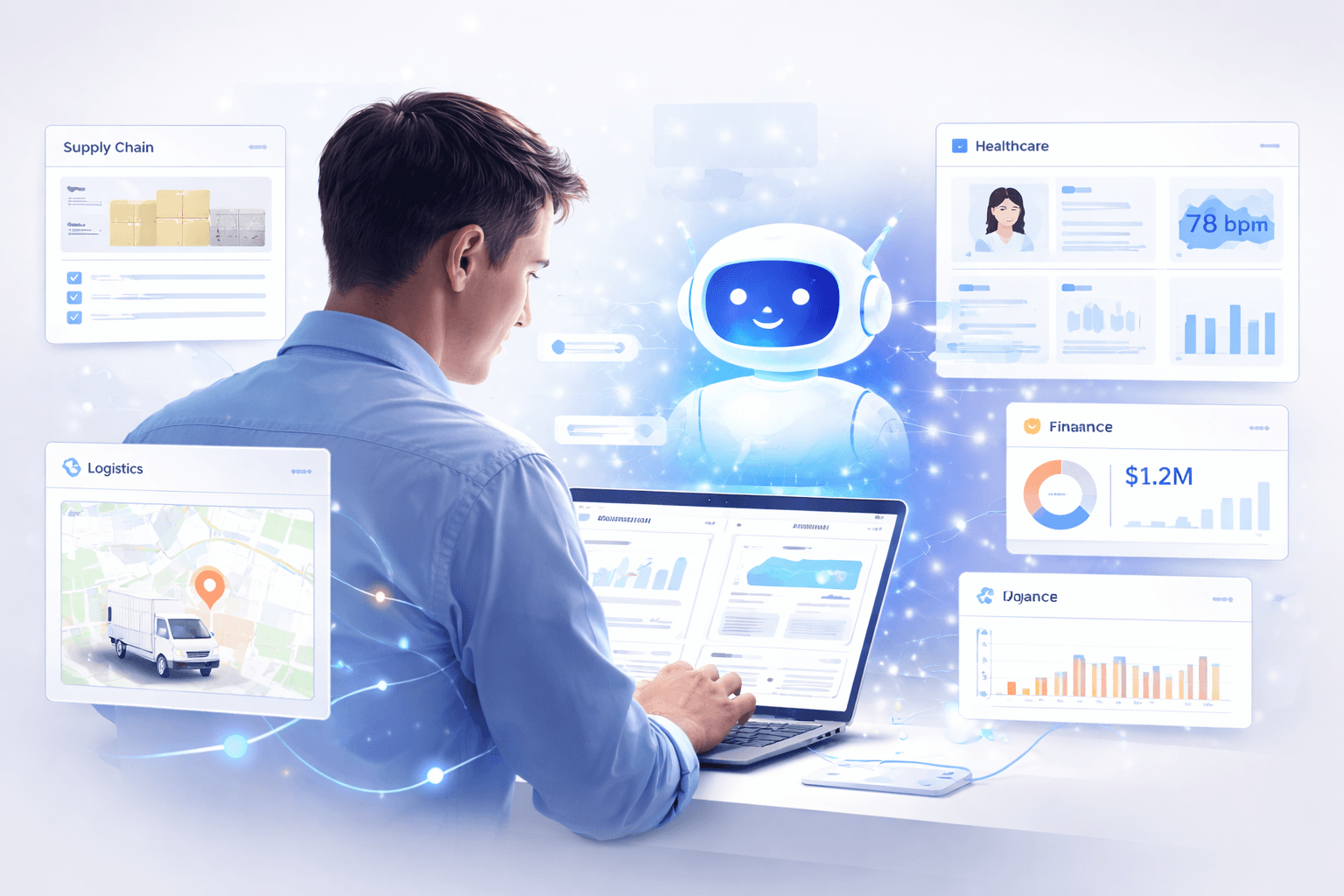
We’ve encoded years of industry-specific patterns and best practices into our foundation. Our design systems aren’t generic component libraries—they’re domain-aware frameworks that understand healthcare workflows, financial processes, manufacturing operations, and more.
But we also know we can’t anticipate every requirement. That’s why we’ve made it easy for teams to teach our AI: correct its outputs, add new patterns, refine existing workflows. Every interaction makes the system smarter for everyone.
The result is faster development without sacrificing quality, standardization without losing flexibility, and AI assistance that actually understands what you’re trying to build.
About Zepity
Zepity is an AI-native application builder built from 20+ years of enterprise software development experience. It helps teams plan, generate, customize, and deploy production-ready business applications using structured organizational knowledge, reusable components, and AI-driven generation. Learn more at www.zepity.com