


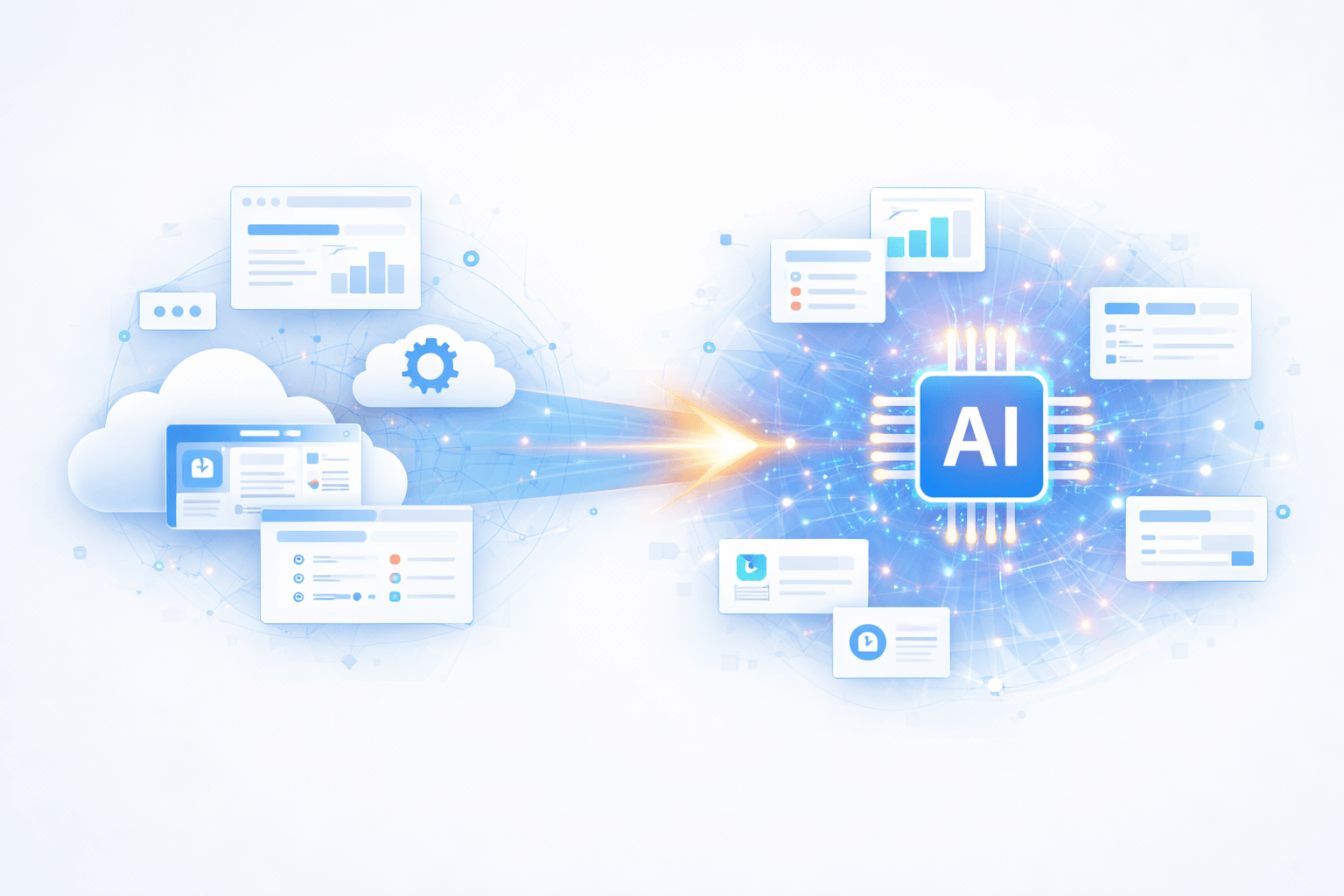
No code AI builders are creating the most significant shift in software since the move from desktop to cloud. We’re witnessing a transformation that goes far beyond faster development or lower costs. Traditional SaaS gave us access to software from anywhere. But no code AI builders are doing something far more profound: they’re democratizing the creation of software itself.
The implications go beyond faster development or lower costs. We’re moving toward a world where software adapts to users rather than users adapting to software—where applications become as unique as the businesses they serve.
The SaaS Evolution: From One-Size-Fits-All to Infinite Customization
Traditional SaaS solved the deployment problem brilliantly. No more server installations, no more version management, no more IT headaches. But it created a new constraint: standardization. When thousands of companies use the same Salesforce instance or the same Slack workspace, features must serve the lowest common denominator.
This is why SaaS platforms feel simultaneously powerful and limiting. Salesforce can track your sales pipeline, but it can’t capture the nuanced qualification process your industry requires. Slack can facilitate team communication, but it can’t enforce the approval workflows your compliance team demands. The software is generic by necessity.
No code AI builders break this constraint entirely. Instead of configuring pre-built software, you’re generating software that matches your exact requirements. The unit of software delivery shifts from applications to capabilities.
Consider the difference:
Traditional SaaS: “We need a CRM. Let’s buy Salesforce and spend six months customizing it to work with our sales process.”
No Code AI: “We need to track prospects through our seven-stage qualification process with automated handoffs between inside sales, technical sales, and legal review. Generate that.”
The first approach forces your business process to conform to software limitations. The second generates software that conforms to your business process.
The Economic Model Revolution for No Code AI
This shift fundamentally changes software economics. Traditional SaaS companies invest enormous resources building features that work for the largest number of customers. Features that serve niche use cases get deprioritized or built as expensive enterprise add-ons.
No code AI builders invert this model. Instead of building features, they build intelligence—the ability to generate features on demand. The marginal cost of a new capability approaches zero because it’s generated, not developed.
This creates a completely different value proposition:
• Infinite customization without infinite cost: Your application can be as unique as your business process without requiring custom development.
• Speed scales with complexity: Complex applications don’t take proportionally longer to build—they just require more sophisticated prompts.
• Continuous adaptation: When your business process changes, your software can evolve instantly rather than waiting for the next release cycle.
• Elimination of feature politics: No more hoping your feature request gets prioritized in someone else’s product roadmap.
The Network Effects of No Code AI Generated Software
Traditional SaaS platforms benefit from network effects—more users generate more data, which enables better features, which attract more users. But these benefits are indirect and slow to compound.
No code AI builders create a fundamentally different type of network effect. Every application generated teaches the AI new patterns. Every business process modeled expands the AI’s understanding of how work gets done. Every industry-specific workflow becomes part of the platform’s collective intelligence.
This creates a virtuous cycle:
1. Pattern Learning: Each generated application contributes new patterns to the AI’s knowledge base.
2. Intelligence Compounding: The AI becomes better at generating applications as it learns from more real-world use cases.
3. Quality Improvement: Better generation quality attracts more users, creating more training data.
4. Ecosystem Expansion: More industry expertise enables the platform to serve new verticals and use cases.
Unlike traditional network effects that benefit users indirectly, this creates direct, immediate value. The healthcare applications generated last month make your healthcare application better today. The supply chain workflows modeled by other users improve your logistics automation.
The Death of Software Categories
The SaaS era gave us software categories: CRM, ERP, HRIS, Marketing Automation, Project Management. These categories made sense when software was expensive to build and deploy. You bought a CRM for customer management, an ERP for operations, and marketing automation for campaigns.
But category boundaries are artificial constraints that don’t reflect how businesses actually operate. Real business processes span multiple systems. A customer complaint might involve your CRM, inventory system, customer service platform, and billing system.
No code AI builders eliminate these artificial boundaries. Instead of assembling solutions from different categories, you generate applications that match your actual business processes—regardless of which traditional categories they span.
Consider these real-world business processes that don’t fit neatly into software categories:
• Customer Success: Combines elements of CRM, support ticketing, project management, billing, and analytics.
• Product Launch Management: Spans project management, marketing automation, inventory management, and sales enablement.
• Regulatory Compliance: Touches document management, audit trails, workflow automation, and reporting across every system.
• Vendor Management: Involves procurement, contract management, performance tracking, and payment processing.
With no code AI builders, you don’t need to force these processes into existing software categories. You can generate applications that handle the complete end-to-end workflow.
The Platform Paradox of No Code AI Builders
Here’s where it gets interesting: as no code AI builders become more sophisticated, they simultaneously become more powerful and simpler to use. This is the opposite of traditional software, where more power typically means more complexity.
Traditional platforms accumulate features over time. Each new capability adds menus, settings, configuration options. Power users can accomplish amazing things, but the learning curve becomes steeper with each release.
No code AI builders work differently. As the AI becomes more sophisticated, it handles more complexity internally. The user interface doesn’t get more complicated—it gets more capable of understanding what you want.
Early AI app builders required precise, technical descriptions: “Create a table with columns for Name (text), Email (email validation), Status (dropdown with values Active, Inactive, Pending), and Date Created (auto-populated timestamp).”
More sophisticated platforms understand business intent: “I need to track our sales prospects through the qualification process.”
The ultimate vision is natural business language: “Help me manage the customer onboarding process more efficiently.”
This inversion—increasing power with decreasing complexity—is what makes no code AI builders fundamentally different from every other software category.
The Ownership Revolution
Traditional SaaS creates a dependency relationship. You pay monthly fees to access someone else’s software. You adapt your processes to fit their design decisions. When they change features, you adapt. When they sunset products, you migrate.
No code AI builders restore a form of software ownership that we lost in the transition from desktop to cloud. You’re not renting someone else’s vision of how work should be done. You’re generating software that embodies your specific approach to solving problems.
This shift has profound implications:
• Process Independence: Your competitive advantages become embedded in your software rather than constrained by it.
• Evolutionary Control: When your business evolves, your software can evolve with it immediately rather than waiting for a vendor’s roadmap.
• Data Sovereignty: Your business intelligence remains in applications you control rather than being aggregated across a vendor’s entire customer base.
• Innovation Freedom: You can experiment with new workflows and processes without convincing a vendor that your use case is worth supporting.
What No Code AI Builders Mean for the Future
We’re moving toward a world where software becomes a utility rather than a product. Just as we don’t think about the infrastructure that delivers electricity to our devices, we’ll stop thinking about the infrastructure that delivers functionality to our workflows.
The defining characteristics of this new generation of business software:
• Generative rather than pre-built: Software is created on demand to match specific requirements.
• Adaptive rather than static: Applications evolve continuously as business needs change.
• Intelligence-first rather than data-first: Platforms compete on the sophistication of their AI rather than the completeness of their feature sets.
• Process-native rather than category-constrained: Applications match business workflows rather than forcing workflows into software categories.
• Collaborative rather than user-passive: Humans and AI work together to refine and improve applications continuously.
This isn’t just an incremental improvement on existing SaaS. It’s a fundamental rethinking of how software gets created, deployed, and evolved. The companies that recognize this shift early will have the same advantage that early cloud adopters had over traditional enterprise software vendors.
The question isn’t whether this transformation will happen. The question is how quickly your organization will adapt to a world where software becomes as flexible as your thinking.
The Zepity Vision
At Zepity, we’re building for this future. Our platform doesn’t just generate applications—it understands business processes. It doesn’t just create interfaces—it embeds industry expertise. It doesn’t replace human insight—it amplifies it.
We believe the next generation of business software should be as unique as the businesses it serves. As adaptive as the markets they operate in. And as intelligent as the people who use it.
The age of one-size-fits-all software is ending. The age of software that fits exactly is just beginning.
Learn more about AI app builder design systems and why human expertise in AI development matters for successful implementations.
About Zepity
Zepity is an AI-native application builder built from 20+ years of enterprise software development experience. It helps teams plan, generate, customize, and deploy production-ready business applications using structured organizational knowledge, reusable components, and AI-driven generation. Learn more at www.zepity.com