


Every business needs a comprehensive AI implementation readiness guide before investing in technology. Six months ago, a mid-sized distribution company invested $50,000 in an AI-powered inventory management system. The technology was cutting-edge. The vendor had great references. The demos were impressive.
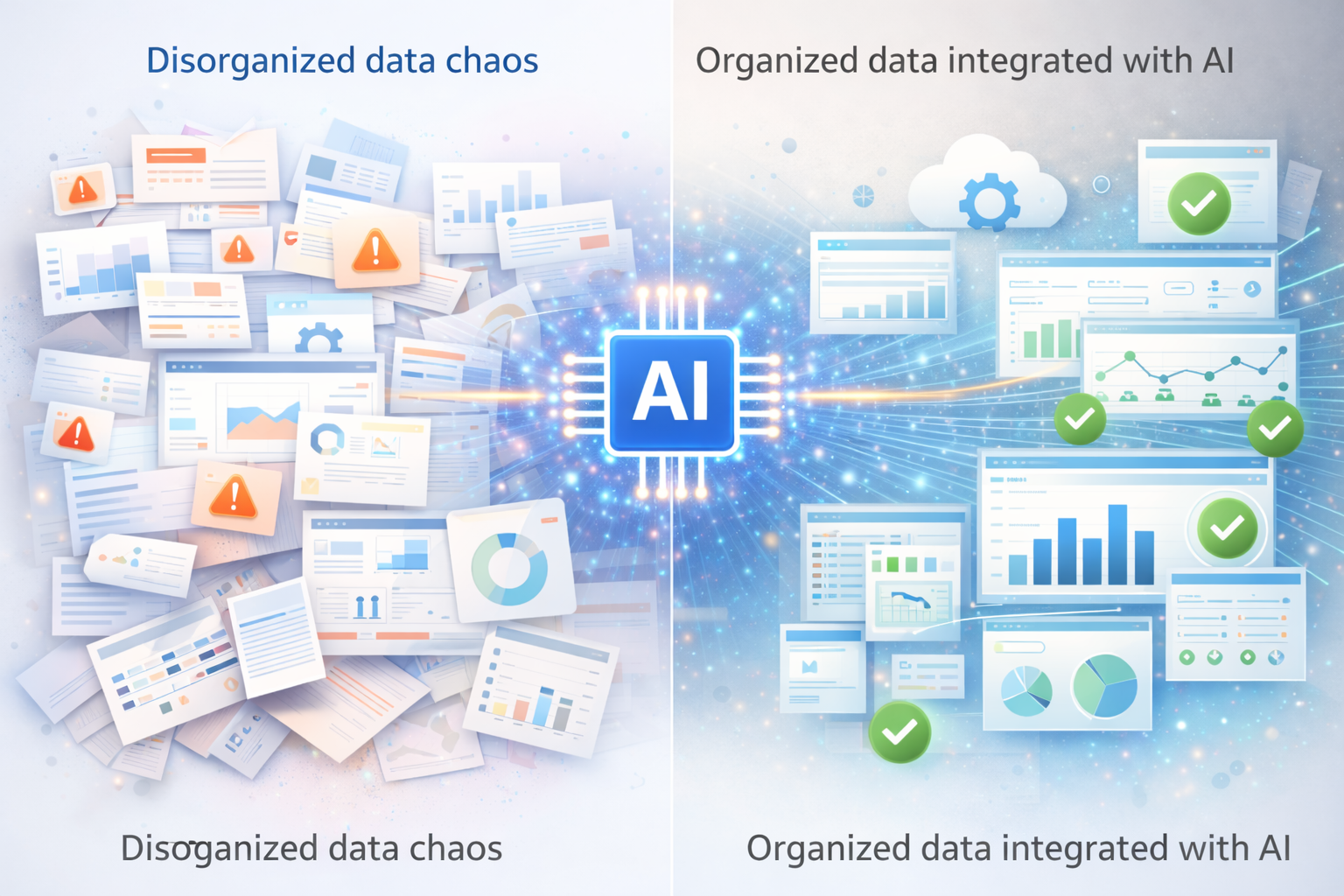
Three months later, the project was abandoned. Not because the AI didn’t work. But because their inventory data was scattered across three disconnected systems, 40% of SKUs had duplicate entries, and product descriptions were inconsistent free-text notes that AI couldn’t parse.
The AI was ready. The business wasn’t.
This is the uncomfortable truth about AI adoption: most businesses aren’t prepared for AI to succeed. Not because they lack vision or budget, but because their data foundation isn’t ready. The good news? AI readiness isn’t a permanent state. It’s something you can systematically improve with the right AI implementation readiness guide.
Every successful AI implementation readiness guide starts with honest assessment.
The AI Implementation Readiness Scorecard: A Quick Refresher
In our last article, Business AI Adoption Strategy, we introduced a simple three-factor assessment. Each factor scores 1-5 (total out of 15):
Data & Document Accessibility – Can AI actually reach your data and documents? Scattered across email and hard drives scores low. Centralized in cloud storage with APIs scores high.
Data Quality – Is it clean and consistent? Major duplicates and missing fields score low. Standardized and well-maintained scores high.
Data Structure – Is it organized for automation? Free-text chaos scores low. Standardized fields and templates score high.
Your readiness level: 12-15 points means you’re ready to implement AI now. 8-11 points means fix data while implementing. 4-7 points means fix your foundation first or waste money on failed implementations.
This scorecard gives you a snapshot of readiness, but how do you actually improve your score? That’s exactly what this AI implementation readiness guide covers with step-by-step improvement plans for each factor.
Knowing your score is just the beginning. This article shows you how to improve it.
A comprehensive AI implementation readiness guide must address all three factors systematically.
Factor #1: Data & Document Accessibility for AI Deployment Readiness
What Good Looks Like
At score 1-2, your critical data lives in email attachments, individual hard drives, and paper files. AI can’t find what it needs.
At score 3-4, you have some cloud storage and key systems, but they don’t talk to each other. Someone has to manually export and import data between systems.
At score 5, everything is centralized in cloud storage, systems are integrated with APIs, and AI can access what it needs programmatically without human intervention.
How to Improve (30-90 Days)
Getting from 1-2 to 3-4 takes about 30-60 days. Start by auditing where your data lives, but only for your top AI opportunity—don’t try to map everything. Choose centralization platforms (Google Drive, SharePoint for documents; Salesforce, HubSpot for customer data; QuickBooks for financials). Migrate the critical data first, archive the rest later. Create folder structures before you move anything.
The key is establishing a single source of truth for each type of data. Once you know where customer data lives, where invoices live, where contracts live, AI can be pointed there.
Moving from 3-4 to 5 takes another 60-90 days. This is about integration—making your systems talk to each other automatically. Tools like Zapier or Make.com handle most integration needs without requiring developers. Connect your CRM to your accounting system. Link your inventory to your e-commerce platform. Eliminate the “swivel chair” processes where someone copies data from one system to another.
Estimated investment: $500-$5,000 in tools and 60-120 hours of effort, depending on complexity.
Factor #2: Data Quality in Your AI Implementation Readiness Guide
What Good Looks Like
AI learns from patterns. Messy data creates messy AI. At score 1-2, more than 30% of your records are incomplete, you have widespread duplicates, and formatting is all over the place. At score 3-4, you have 10-30% issues—manageable but requiring cleanup. At score 5, less than 10% of records have problems, duplicates are rare, and you have strong data governance.
The difference: Score 1-2 AI generates incorrect outputs constantly. Score 3-4 AI produces decent results but needs human oversight. Score 5 AI delivers reliable results you can trust.
How to Improve (60-90 Days for Major Cleanup)
The big cleanup from 1-2 to 3-4 takes focused effort. Export your key datasets and run a quality analysis. How many records are missing critical fields? How many duplicates exist? Is formatting consistent (company names, phone numbers, addresses)?
Focus only on data needed for your first AI opportunity. Don’t audit your entire database.
Then tackle it systematically. Use your CRM’s built-in deduplication tools to merge duplicates—but review them manually before merging. Fill missing information by calling customers or checking invoices. Standardize formatting with find-and-replace or bulk updates. Pick one format for everything and enforce it.
Create a simple data entry guide with examples. Show your team what “correct” looks like. Then implement validation rules in your systems so bad data can’t get in anymore. Required fields can’t be skipped. Email addresses must look like email addresses. Phone numbers must match a pattern.
Moving from 3-4 to 5 is about systematic quality control. Set up automated validation that enforces standards at data entry. Create monthly quality reports showing completion rates, duplicates found, and records not updated recently. Assign ownership—someone needs to be responsible for customer data quality, someone else for product data. Make it part of their role, not an afterthought.
Estimated investment: $0-$10,000 for tools and possible temporary help with manual cleanup. Plan for 60-120 hours of effort depending on how messy things are.
Factor #3: Data Structure for AI Implementation Readiness
What Good Looks Like
Structure is about whether information is in standardized fields or buried in free-text chaos. At score 1-2, critical information lives in unstructured notes, email threads, and inconsistent documents. At score 3-4, you have some structure but it’s not consistently enforced. At score 5, everything uses standardized fields, templates, and proper categorization.
The impact: Unstructured data makes pattern recognition nearly impossible for AI. Structured data gives AI clear, consistent information to work with.
How to Improve (30-90 Days)
Moving from 1-2 to 3-4 means imposing structure where chaos exists. Look at where critical information currently hides. Customer support tickets buried in email? Create a structured form with dropdown categories (shipping issue, billing question, product defect) instead of free-text descriptions. Project information scattered in notes? Build a template with standard fields for client name, budget, timeline, status, and deliverables.
The key is replacing unstructured capture with structured capture. Instead of “email us your issue,” use a form with specific fields. Instead of free-form project notes, use a template. Instead of documents named randomly, enforce naming conventions and metadata.
You don’t need to restructure everything—just what matters for your AI implementation. Use OCR tools like Adobe Acrobat or Google Drive to extract text from scanned documents. Consider AI text extraction services for large volumes. Prioritize active records over historical archives.
Getting from 3-4 to 5 is about comprehensive metadata and enforcement. Every document should have metadata captured automatically (who created it, when) and manually (what project, what client, what status). Use hierarchical categories instead of dumping everything into “Miscellaneous.” Implement workflows that won’t let people skip required fields or upload documents without proper tags.
The goal is making it impossible to bypass structure. Required fields, validation rules, and workflow enforcement make good data entry the path of least resistance.
Estimated investment: $0-$10,000 depending on tools and migration help needed. Plan for 40-80 hours for initial structure implementation, then 40-80 more hours for comprehensive enforcement.
Your 90-Day AI Implementation Readiness Guide Plan
You can’t fix everything in 90 days. You don’t need to. The goal is improving enough to implement your first AI solution successfully, then continuing to improve while it runs.
This AI implementation readiness guide provides a practical 90-day framework for systematic improvement.
Month 1: AI Implementation Readiness Assessment and Accessibility
Complete your readiness assessment for your top 3 pain points. Choose the one with the highest score—even if it’s not your biggest pain. This is your target. Create a detailed improvement plan focused only on that use case.
Begin centralizing data and documents for that specific pain point. Set up folder structures. Start migrating critical data. Don’t worry about historical archives yet.
Month 2: AI Readiness Data Quality Cleanup
Run your deduplication process. Fill in missing fields for active records. Standardize formatting for company names, phone numbers, addresses—whatever fields matter for your AI opportunity.
Create your data entry guide and implement validation rules. Train your team. Make it impossible to enter bad data going forward.
Month 3: AI Implementation Structure and Launch
Create templates and forms to capture information consistently. Convert unstructured content to structured fields. Implement required metadata and workflow enforcement.
In Week 11, re-score your readiness. You should be at 12+ out of 15. Week 12, launch your AI pilot for this pain point.
Months 4-6: Rinse and Repeat
While your first AI solution runs, apply the same process to your next pain point. Each cycle gets faster because you’ve built the foundation and understand the process.
Common AI Implementation Readiness Mistakes to Avoid
Don’t try to fix everything at once. Focus on one pain point. Get one AI solution working. Then move to the next. Small wins build momentum better than overwhelming comprehensive projects that never finish.
Don’t wait for perfect. A 12/15 readiness score is good enough to start. You’ll learn more from running an imperfect AI implementation than from six months of data cleanup. Improve while running, not instead of running.
Don’t skip data quality for accessibility. Centralizing messy data just means AI can access bad information faster. Balance improvements across all three factors before launching.
Assign clear ownership. “Everyone’s responsibility” means no one’s responsibility. One person owns accessibility, one owns quality, one owns structure. Review progress weekly.
Enforce through systems, not policy. Teams will revert to old habits if you only rely on training. Make it impossible to save incomplete records or upload documents without metadata. Remove workarounds.
Add a 25% time buffer. If you think cleanup will take 2 weeks, plan for 3. Better to over-deliver than under-deliver and lose executive support.
Real AI Implementation Readiness Success Stories
Healthcare Practice: 6/15 to 13/15 in 75 Days
Started with patient data scattered everywhere, significant duplicates (3,500 records for 2,800 actual patients), and inconsistent formatting. In Month 1, they migrated to a cloud-based system and digitized paper files. Month 2 was deduplication and standardization. Month 3, they created structured intake forms and appointment categories.
Result: Successfully implemented AI appointment scheduling, reduced no-shows by 35%, freed staff for patient care instead of phone calls. Investment: $3,500 and 80 hours of internal time.
Manufacturing Company: 8/15 to 14/15 in 90 Days
Production data was partially structured but inventory disconnected, lots of SKU duplicates. They spent $3,000 on Make.com to integrate systems, cleaned up 200 duplicate SKUs, and implemented structured data capture at each production stage.
Result: AI quality control working in 120 days, 90% reduction in defects reaching customers, real-time production visibility. Investment: $6,200 and 90 hours internal time.
Professional Services Firm: 5/15 to 12/15 in 60 Days
Contract templates scattered, client data messy, project info in email chaos. Month 1 they centralized templates in Google Drive with required metadata. Month 2 was client data cleanup and standardization.
Result: AI document generation for contracts, creation time dropped from 3 hours to 20 minutes. Investment: $800 and 50 hours internal time.
The AI Readiness Investment That Pays Forever
Failed AI implementations waste $50K-$200K+ and kill team confidence. Meanwhile, competitors who got their data ready pull further ahead.
But when you invest in readiness, every dollar compounds. The manufacturing company spent $6,200 improving data readiness and saved $150K/year in defect reduction. That’s 2,300% ROI in year one, and the benefits continue indefinitely. Better data helps every part of your business, not just AI.
Your Next Steps
This week: Complete the readiness scorecard for your top 3 pain points. Choose the one with the highest score.
This month: Create your 90-day improvement plan. Assign ownership. Begin Month 1 activities.
Next 90 days: Execute the plan. Track progress weekly. Prepare for AI pilot launch in Month 4.
The businesses winning with AI in 2030 aren’t the ones with the best technology. They’re the ones who built solid data foundations in 2025.
Don’t wait for perfect. Start with good enough. Improve while running.
The time to get ready is now.
Every AI implementation readiness guide concludes with the same truth: action beats perfection.
About Zepity
Zepity is an AI-powered application builder designed for enterprise needs. We help businesses assess their AI readiness and build solutions that work with real-world data. Our platform includes AI document processing, chatbots, workflow automation, and analytics—all designed to deliver results even when your data isn’t perfect. Learn more at www.zepity.com