


Every software company says “AI powered” now. Most of them mean the same thing: they added a chat interface to an existing product, or they let you type a sentence and it generates some output. That is useful in a narrow sense. But it is not an AI business automation platform, and it is not running your business.
If you are evaluating an AI business automation platform, whether for a CRM, a scheduling tool, a project management system, or anything else, there are specific things worth checking before you believe the pitch. Some of these are easy to overlook because they do not show up in a demo. They only show up after six months of actually using the platform.
Here is what to look for.
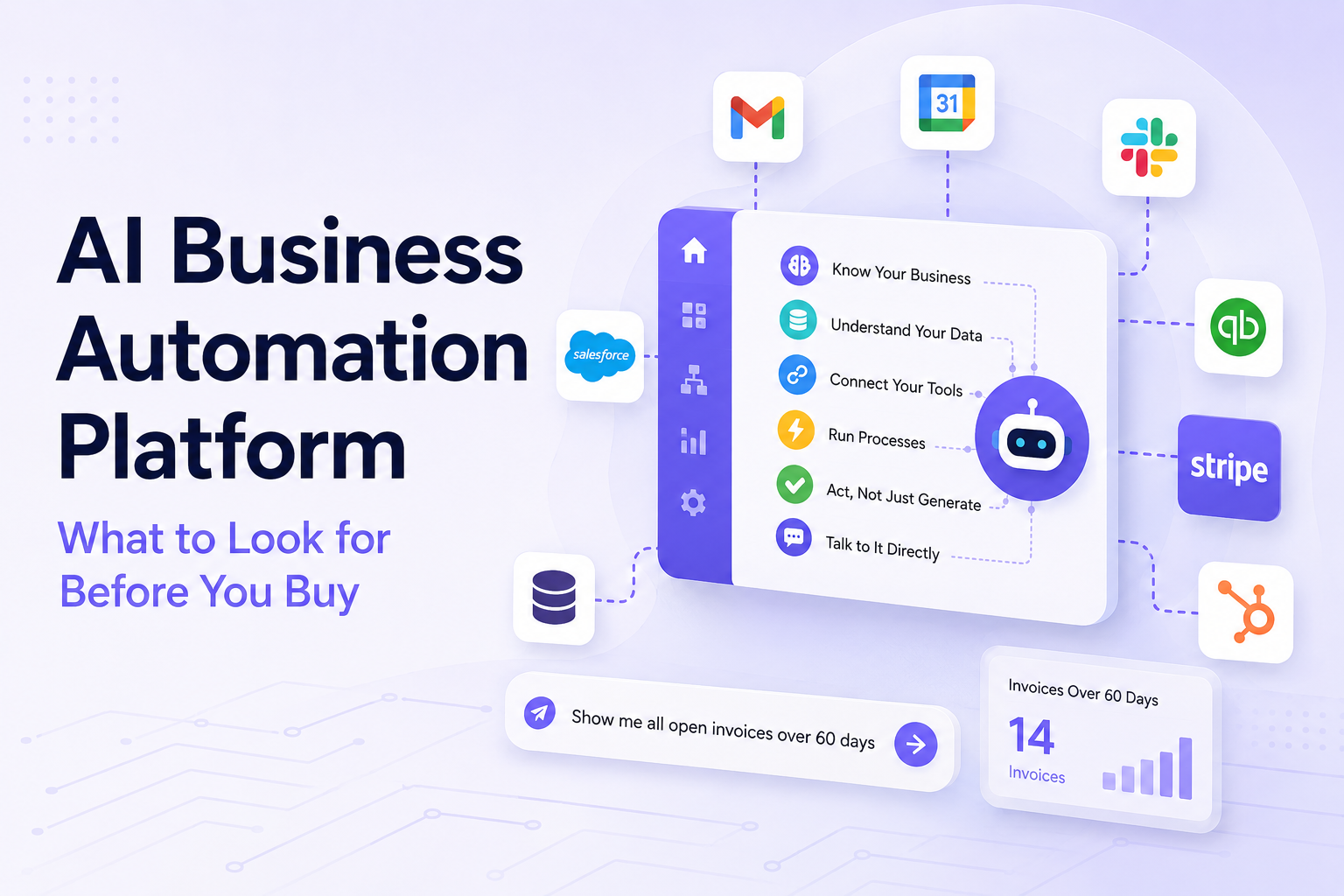
An AI Business Automation Platform Has to Actually Know Your Business
An AI tool is only as good as what it knows. If it is reading whatever you type into a prompt box that day, it is starting from zero every time. A real platform should have somewhere for your business knowledge to live: your policies, your processes, your product details, the things a new employee would need explained on day one. And that knowledge needs to be something the AI can actually reference and reason with, not just a folder of documents nobody reads.
This is the difference between a chatbot and a business automation system. One answers questions based on whatever you just typed. The other operates from a structured understanding of how your business actually works.
An AI Business Automation Platform Has to Understand Your Real Data
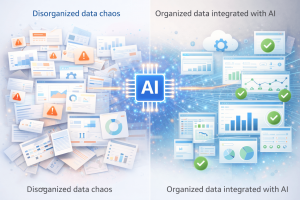
Knowledge and data are different things. Your knowledge base might describe your refund policy. Your data is the actual list of customers, orders, and transactions that policy applies to. A platform that handles only one of these is half built.
If the AI can discuss your business in general terms but cannot look at a specific customer record and take action on it, it is not automating anything. It is chatting. A genuine AI business automation platform connects business knowledge to business data, so AI operates in the context of what is actually happening, not just what the policy says should happen.
It Has to Connect to What You Already Use
No business runs on a single application. You have email, payment processing, calendars, accounting software, and industry-specific tools you have built your operations around for years. If the platform you are evaluating cannot connect to those systems, it is an island. You will end up doing the connecting yourself, manually, which defeats the purpose of buying an automation platform in the first place.
Before committing to any platform, ask specifically which systems it integrates with and how deeply. A surface-level connection that can read data is different from a deep integration that can trigger actions and respond to events. The depth of integration determines the scope of what the platform can actually automate.
It Has to Run Processes on Its Own
This is the difference between a tool that helps you and a tool that works for you. A real AI business automation platform should look at a condition, a new lead coming in, an invoice becoming overdue, a task being assigned, and take the next step automatically without someone clicking a button every time.
If every action in the system still requires a human to initiate it, you have not automated anything. You have made clicking slightly easier. True automation means the platform monitors conditions and acts on them, independently, based on the rules and workflows you have defined.
An AI Business Automation Platform Has to Act, Not Just Generate
There is a meaningful difference between AI that writes something for you and AI that does something for you. Many tools stop at generation. They will draft an email, summarize a document, or suggest an answer, and then a human still has to go execute it.
A true AI business automation platform hands real tasks to AI agents and has those agents carry them out inside the actual system. Not describe what should happen next. Not generate a draft for a human to copy and paste. Actually act: update the record, send the communication, trigger the next step in the workflow.
You Should Be Able to Talk to It Directly
If everything above is built correctly, something important becomes possible: you should be able to ask the platform questions in plain language and tell it to do things instead of hunting through menus and forms.
“What happened with this account last week.” “Send a reminder to everyone who has not responded.” “Show me all open invoices over sixty days.”
If a platform has all the structure described above but no conversational interface, you are leaving most of the value on the table. The goal is a system that feels less like software you operate and more like a knowledgeable colleague you can direct.
The Question Almost Everyone Skips
Here is the part nobody puts on the homepage, and the one that actually matters most.
The moment an AI business automation platform can take real action on its own, hand real tasks to an agent, and run real automations, you have to ask a harder question: what stops it from doing something wrong?
Any platform that allows AI to act autonomously needs a clear, specific answer to this. Before an AI agent is allowed to take an action independently, there should be a defined standard for what done correctly actually means for that particular action, and a real check that confirms it happened that way.
This matters more the more autonomy you give the platform. An AI that drafts a suggestion is low risk if it gets something wrong. An AI business automation platform where agents can update records, send communications, and take actions in your business needs guardrails that are built in from the start, not added as an afterthought. If a vendor cannot clearly explain what happens when their AI gets something wrong, that is worth taking seriously before you hand it real responsibility.
An AI Business Automation Platform Should Get Smarter Over Time
The best version of this is not a static tool you configure once and forget. As you add knowledge, enter data, connect systems, and let automations run, the platform should build an increasingly complete picture of how your business operates. That picture, often called a knowledge graph, is what the AI references whenever it is asked to help or act.
This should happen naturally, as a byproduct of using the product, not as a separate project you maintain on the side. A platform that is the same on day one hundred as it was on day one is not learning anything. A platform that compounds, getting more useful as it accumulates more context about your business, is one worth building on.
Questions Worth Asking Before You Buy
If you are evaluating an AI business automation platform, these questions will tell you more than any demo:
Can it see and use your real business data, not just chat about general topics? Does it connect to the tools you already use, or will you be stuck doing manual handoffs between systems? Can it run a process automatically, or does a person still have to trigger every step? If it hands work to an AI agent, what confirms the work was done correctly? What happens when it gets something wrong? And does it understand your business better over time, or is it the same tool on day one hundred as it was on day one?
Most AI tools on the market today can answer two or three of these clearly. The ones worth paying attention to can answer all of them.
Zepity is built to answer all of them. Our platform combines a structured knowledge base, deep integrations, data management, an AI-native workflow engine, and a hybrid task model where work is routed to humans, AI agents, or both depending on what each task requires. The result is a system that learns how your business operates and gets more capable over time. Learn more at www.zepity.com.
About Zepity
Zepity is an AI-native application builder designed for enterprise needs. Built from 20+ years of enterprise software experience, Zepity helps teams plan, generate, customize, and deploy production-ready business applications faster using structured organizational knowledge, reusable components, and AI-driven generation. Learn more at www.zepity.com