


Agent Experience AX is emerging as the most important new design discipline in software. Most designers have not made the shift yet. In 1993, Don Norman coined the term User Experience (UX). That single reframe changed everything, giving us interaction design, usability testing, human-centered design, accessibility standards, and thirty years of discipline built around one core principle: understand the person, design for the person.
That principle is not going away. But it is no longer sufficient.
Because the person using your software is increasingly not the only one using it. AI agents are using it too. And they have a completely different experience of it than humans do.
In January 2025, Netlify CEO Mathias Biilmann introduced a term for this: AX, or Agent Experience. He positioned it deliberately alongside UX and DX (Developer Experience) as a third design discipline for a new era. As a result, the experience AI agents have when interacting with your product is now a design problem that matters as much as the experience humans have.
For designers who have spent their careers thinking about software from a human-centered perspective, Agent Experience AX represents the most significant mindset shift in a decade.
What Agent Experience AX Actually Means
Agent Experience AX is the holistic experience AI agents have when interacting with a product, platform, or system. It covers how easily an agent can access your product, understand what it does, call it reliably, and recover when something goes wrong.
That might sound like a technical concern, an API problem rather than a design problem. In reality, however, it is absolutely a design problem. The choices designers and developers make about data structure, interface logic, state management, output format, and error handling all determine whether an agent can use the product effectively or not.
The parallel to UX is exact. When UX emerged as a discipline, the insight was that building software that technically worked was not enough. It had to work for the human using it, intuitively, efficiently, and without unnecessary friction. The same insight now applies to agents. Building software that technically functions is not enough. It has to function for the agent using it, predictably, consistently, and without ambiguity.
A human can interpret a confusing interface. They can make inferences, ask questions, and adapt to inconsistency. An agent, however, cannot. It needs clean, structured, unambiguous inputs and outputs. Where bad UX frustrates a human, bad Agent Experience AX breaks an agent entirely.
The Three Disciplines: UX, DX, and AX
To understand where Agent Experience AX fits, it helps to see the full progression.
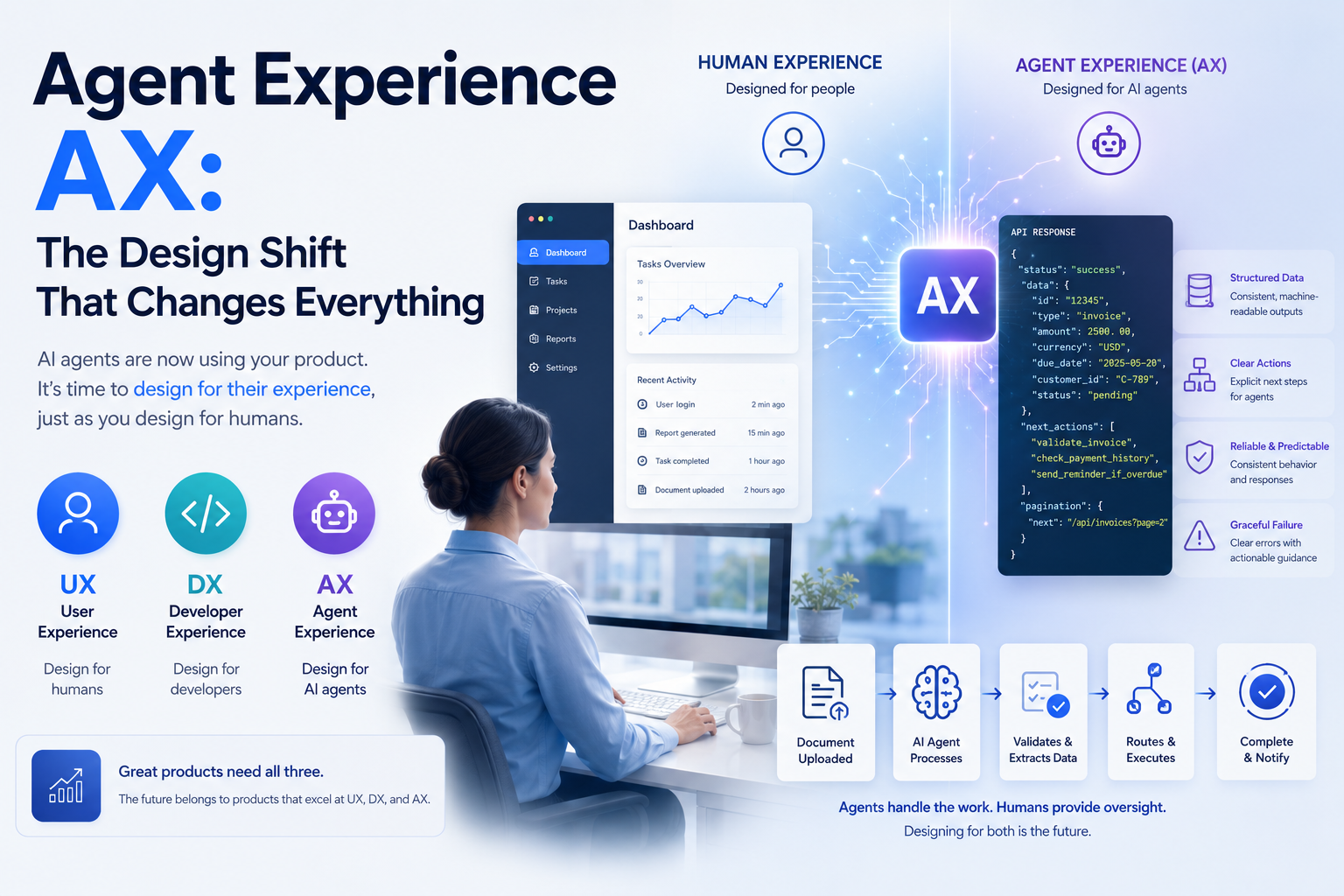
UX, or User Experience, optimizes for the humans using your product. Can a user understand this interface? Can they complete their task efficiently? Thirty years of practice has given us rich frameworks for answering these questions.
DX, or Developer Experience, optimizes for the developers building on your platform. Is the API intuitive? Is the documentation clear? How quickly can a developer integrate? Companies that invested in DX discovered enormous competitive advantages, because better DX meant more developers building on their platform, which created larger ecosystems and more value for everyone.
AX, or Agent Experience, optimizes for the AI agents increasingly acting on behalf of both users and developers. Can an agent discover what this product does? Is your API reliable enough for it to call repeatedly, interpret outputs, and act on them? And when something fails, does it recover gracefully?
These three disciplines are not in competition. In fact, a great product needs all three. Most design teams are fluent in UX, developing in DX, and have barely started thinking about Agent Experience AX. That gap is precisely where the next wave of competitive advantage is being created.
What Designing for Agent Experience AX Requires
Here is where the design discipline gets genuinely new and interesting.
Structure over style. Human-centered design invests enormous effort in visual hierarchy, typography, color, and layout. These things matter for humans. They are, however, largely irrelevant to agents. What agents need is structural clarity: consistent data models, predictable field names, unambiguous categories, and clean outputs that mean the same thing every time.
Explicitness over inference. Humans are remarkably good at inference. They read between the lines, interpret ambiguous labels, and fill gaps with context. Agents, by contrast, cannot do any of that. Every piece of information an agent needs has to be explicitly available through clear labels, complete metadata, documented schemas, and unambiguous state.
Predictability over flexibility. UX often values flexibility, giving users multiple ways to accomplish the same task. For agents, however, flexibility creates uncertainty. Agent Experience AX design therefore prioritizes consistent, predictable behavior over flexible, human-friendly variation.
Graceful failure over happy path. When an agent encounters an error, it needs a clear, actionable signal, not a generic error message designed for a human, but a structured response that tells the agent exactly what went wrong and what it can do next.
The Part Most Articles Miss
Most writing about AX focuses on one side: designing products so that agents can use them. That is important and under-discussed.
There is, however, a second side that is equally important and almost entirely ignored: designing the human interface for a world where agents are doing most of the work.
When an agent handles the routine work inside a product, the human role changes fundamentally. Rather than performing tasks directly, they are overseeing an agent that performs those tasks. As a result, what the human-facing interface needs to do changes completely.
The human in an AI-integrated product is a manager, not an operator. They need to see what the agent is doing, understand why it made the decisions it made, review exceptions it could not handle autonomously, and trigger new sequences when the situation calls for it.
This is where UX and Agent Experience AX intersect, and that is where the most interesting design problems live. Designing that interface requires everything UX has always required, but applied to a completely different human task. Not entering data. Not navigating menus. Instead, managing, reviewing, correcting, and directing an agent that does all of that.
For a practical look at how this changes the way you think about building software, read our article on AI integration mindset.
The New Design Language: Conversation
The interaction model changes significantly when Agent Experience AX enters the picture. Traditional UX is built around manipulation: clicking, dragging, filling fields, navigating menus. These patterns make sense when a human is performing the work step by step.
When the human role shifts to directing and overseeing an agent, however, the natural interaction model becomes conversation. The human expresses intent, the agent interprets and acts, and then the human reviews and refines. Over time, the agent learns and improves from each exchange.
This is not just a chat window. Conversational UI in enterprise software has to be trustworthy and auditable in ways that casual chat is not. For example, the human needs to see what the agent understood, what action it took, what it decided when uncertain, and what the audit trail looks like for every action taken.
Think of it as designing the relationship between a manager and a highly capable but very literal assistant. The manager speaks in natural language, the assistant acts and confirms, and when uncertain it escalates rather than guesses. Subsequently, the manager reviews, corrects, and approves. Every exchange is logged and traceable.
Why Agent Experience AX Matters Right Now
UX emerged as a discipline in the 1990s during a window when patterns that defined the next twenty years of software were being established. The teams that invested in UX early built advantages that compounded over decades.
Agent Experience AX is at the same inflection point now. Consequently, the patterns being established today will define what normal looks like for the next decade.
For designers and developers, this is not a threat to the discipline. It is an expansion of it. UX is not going away. Rather, it is evolving into something that requires everything UX always required, plus a new layer of thinking about agents as users, data as the design medium, and conversation as the primary interaction model.
The designers who make this shift now will build products that work in a world where both questions matter equally: how does a human experience this, and how does an agent experience this?
That world is already here. Agent Experience AX is the design discipline that serves it.
At Zepity, we build enterprise applications with both questions in mind from day one, designing for the agents doing the work and the humans overseeing it. Learn more at www.zepity.com.
About Zepity
Zepity is an AI-native application builder built from 20+ years of enterprise software development experience. It helps teams plan, generate, customize, and deploy production-ready business applications using structured organizational knowledge, reusable components, and AI-driven generation. Learn more at www.zepity.com